|

|
July 2006
|
|
10th July, 2006 |
|
BALI DIARY: |
|
One's first impression
of Bali is of a Hindu island in a Muslim country. The next thing to
strikes you is that this is a country designed by tourists, for tourists
and the pleasures of tourism. From the tinkling relaxing music played on
the Denpasar (the capital of Bali) airport sound system, to the
seemingly sincere and warm 'namaste' type of greeting, plus the welcome
privilege of a visa being granted on arrival (even to Indians!) you (and
your money) are made wholeheartedly welcome. |
|
History and geography in brief: Bali is part of the Indonesian archipelago and located east of Java and west of the island of Lombok. In 1343, the East Javanese Hindu Majapahit dynasty conquered Bali. Sometime in the 16th century, the Majapahit Empire fell to invading Islamic forces forcing artists, intellectuals, scholars and priest to migrate to Bali. Then came the Dutch who (in the fashion of most colonial powers of that time), came in as traders and ended up as rulers after a ruthless and bloody conquest. The Dutch lost out to the Japanese during the Second World War after which the Balinese regained control of their island after several centuries. |
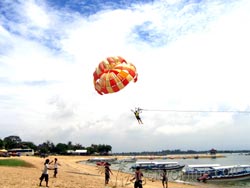 |
| Parasailing
on Benoah Beach |
|
|
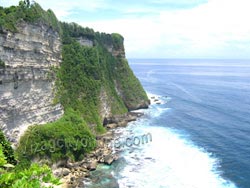 |
| The
Cliffs of Uluwatu |
|
India on my mind: The influence of India is all over the island. From words such as 'Garuda'' Saraswatee' 'Wisnu' 'Brahma' 'Wana' 'Rajah' 'Muka (face)'etc., to the food and the culture such as dance forms. Apart from the ancient historical connections with this island, India's present day standing as a regional 'big brother' and its growing clout as far as 'soft power' is concerned, was clearly evident. "You from India?" "You know Shahrukh Khan?" "Kuch kuch hota hai?" were fairly common words of introduction.
Alas, one of the things also exported from India was the caste system - though certainly not as evident, rigidly observed, and firmly entrenched as it is here. |
|
|
We stayed in a luxurious private villa in the upmarket Seminyang area just north of Kuta (meaning city: from our 'Kota' - fort?). This trendy area with its happening nightlife, stylish boutiques and fancy eateries was also the scene of the October 2002 bombing which had resulted in a major reversal of perception and fortunes for Bali. The place is still trying to recover from this act and prove that the incident was an aberration. |
|
Shopping: To lovers of art, this place is heaven. Beautiful paintings at reasonable prices, sculptures in ebony, colourful batik prints are some of the exclusively Balinese things to shop for. We also eyed the abundant (not surprising, with all that tropical rain forest around) beautiful and sturdy furniture but practical difficulties of shipping it to Vizag, made us pass up this shopping opportunity. Very often, ignoring their own currency, the Indonesian Rupayah, prices, we found, were very conveniently rounded off to the nearest ten dollars. "How much does this cost?" "Ten dollars" (haven't you heard of 1, 2, 3….?) or "20 dollars" (hello: 11, 12, 13, 14..?). The larger stores in Kuta had fixed prices that saved you the haggling even if a little more expensive than other areas. |
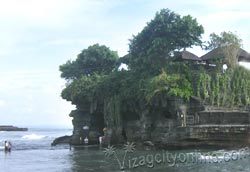 |
| The
Temple of Tanah Lot |
|
|
|
Temples, more temples and still more temples: The main religion in Bali (over 98% of the population) is the
Agama Hindu Dharma which is based on the Hinduism of India but has influences of Buddhism and indigenous beliefs such as the worship/appeasement of spirits. The Hindu trinity of Brahma, Shiva and Vishnu are worshipped but are seen as manifestations of their God
Sanghyang Widhi. Not surprising then that the place is crawling with temples. At Pura Besakih, Bali's mother temple containing separate sections devoted to Brahma, Vishnu and Shiva, standing against a breathtaking mountain backdrop on the southeastern slopes of Mount Agung (which erupted in 1963 killing over a thousand people but spared the temple complex itself) we were greeted with a "Khem cho? Majama?" by a local guide/tout - evidence of frequent visits of large numbers of garrulous globetrotting 'Gujjus'. The complex also houses the oldest remaining gamelan instrument in Bali called selonding. |
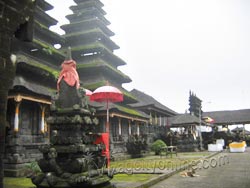 |
| Pura
Besakih |
|
Part of a series of sea temples on the south coast of Bali (the others being Pura Sakenan, Pura Ulu Watu, Pura Rambut Siwi and Pura Peti tenget ) the temple of
Tanah Lot, about 20 kilometers from Denpasar, is a small but majestic temple that lies on a rocky outcrop accessible at low tide (wading through about waist-deep water and dodging crashing waves) reminiscent of the Dargah at Haji Ali, Mumbai though it resembles Kanyakumari and the Vivekananda Rock Memorial not just in appearance but in the fact that both are situated at southern extremities of land masses. The temple complex with foliage overhanging the hill north of this rock/temple is beautiful and speaks volumes of the human effort that must have gone into its creation. Most visitors to Tanah Lot, both locals and tourists, throng to the place daily to catch a glimpse of the romantic Tanah Lot sunsets during the dry season (April to November). |
|
|
The temple complex at Uluwatu (Pura Uluwatu) is a 'directional' temple protecting Bali from evil spirits from the South West (Vaastu?). It lies at the south eastern tip of Bali in the Badung Regency and has an arched gateway at the entrance flanked by statues of Ganesha. The temple was built in the eleventh century by Empu Kuturan a Hindu Javanese priest. Another priest, Niratha, is said to have attained moksha here in the seventeenth century. Told that wearing of a Sarong was mandatory to enter the temple, we ingenuous Vizagites decided to make do with sarees draped as lungis over our trousers to avoid the unnecessary one-time expense. Fortunately, our ingenuity was not put to test as they did not insist on it and we were allowed in with just a bright yellow sash given to us. That was the closest I've come so far to wearing a saree! Wandering around the complex and watching the waves far below the cliff, I was reminded of the movie 'Papillon' (Dustin Hoffman?) that I had seen during my childhood in Vizag. Uluwatu is also a popular surfing spot. I've often wondered why I've never seen anyone even attempting to surf at Vizag's beaches; sitting in a Warung (small restaurant) which offered a wonderful vantage point of the beach and watching the giant waves that gradually built up before breaking, I realized why - we just don't have that type of beach in Vizag. This otherwise enjoyable visit to Uluwatue was marred by a troop of monkeys at the temple were real pests. |
|
Art & culture: Most art in Bali is inspired either by stories from the Ramayana and other Hindu epics or based on local beliefs and way of life (fishing, agriculture). The center in Bali for art and culture is the Ubud area with several art galleries and museums. The place is said to have been developed by one Walter Spies (a German) in the 1930s when Bali was just being discovered as a tourist destination. On our visit here, apart from buying several beautiful paintings at an art gallery, we visited a batik factory (more of a small-scale industry) with an attached sales outlet. There was no hard sell here but the guide cleverly made the process of weaving, waxing and dyeing seem so interesting that we ended up wanting to buy several pieces. |
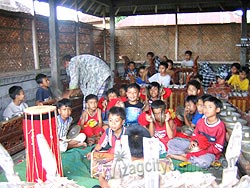 |
| Children
at Temple Music School |
|
|
|
Other sights and activities: Being an established tourist destination, there are very few activities one can not indulge in, in Bali. We had a mind-boggling array to pick from: water sports, scuba diving, spa treatments, game fishing, golfing, white water rafting, trail riding, bungy jumping, dance, music and meditation classes…. We settled for the must see items except for some paragliding on Benoah beach which was great fun. Among the sights were: the mountain village of Kintamani with spectacular views of Lake Batur (14 km long) and the still active volcano of Mount Batur (Gunung Batur). We were told that Kintamani, earlier known as Semarapura, was once the center of Bali's most important kingdom and the site of a massacre by the Dutch in 1908 of the Rajah and his family of last Balinese kingdom to succumb. We also visited the Monkey Temple (Pura Dalem Agung, Temple of the Dead) and forest (Mandala Wisata Wanara Wana).
|
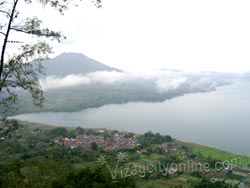 |
| Spectacular
View of Lake Batur |
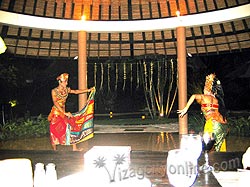 |
| The
Graceful Legong Dance |
|
Bahasa
Confusia: You can get by with English quite well in Bali. The local languages are Bahasa Bali (native to Bali) which is entirely different from Bahasa Indonesia imposed by the 'mainland'. From what we read, no definitive grammar guides Bahasa Bali and there is lots of variation in different parts of Bali. The language also varies according to status of speaker, the person being addressed, and person being referred to. There are five main forms of the language: Basa Lumrah, (used between friends or people of same caste); Basa Sor (for talking to lower castes and foreigners); Basa Alus, (used among educated people, derived from Hindu-Javanese court languages); Basa Madia, used when wishing to show respect to outsiders. Basa Singgih, based on the ancient Hindu Kawi language is used to address upper castes in formal or religious contexts. The script resembling Sanskrit could be found on welcome and farewell signs outside Balinese villages. Some of the characters seemed to resemble Telugu very closely. Who knows? Those early settlers carrying the Hindu influence might have set sail from Vizag for all we know! However it is Bahasa Indonesia which is taught at schools and used in all administrative areas. |
|
|
On the last but one day, we decided to take it easy. A relaxing Spa treatment lasting over four hours costing over a hundred dollars (no way would I pay 4000 Rupees for this; but 100 dollars seems okay!) was followed by a Legong dance (a traditional palace dance) performance by pretty, graceful and shy girls who must have been in their early teens accompanied by a 'gamelan' orchestra. According to legend, Legong is based on the heavenly dance of divine nymphs; my theory is that it is based on Bharatanatyam - the same darting eyes, expressive gestures and rhythmic footwork. Craving for some Indian food by now we visited an Indian restaurant, the Golden Tandoor, where the food was excellent but the service and attitude, unfortunately, desi.
On our last day at Bali, we went North West to Menjangan (meaning 'deer' after the deer found here) island about 30 minutes by boat from the main island. The clear water, colourful fish and coral, the stunning change in depth from a few metres to a bottomless ocean were worth the long drive and boat ride. Despite the beauty and the serenity of the place and the basic decency of the people, there were minor irritants. We came across several instances of touts and wayside vendors trying to pull wool over tourists' eyes as is common in many third world countries. Examples of these were the displaying of a beautiful carving/painting, agreeing to a price reluctantly after much haggling and then switching it with a similar one of far inferior quality at the last minute. It takes a third-world person from Vizag to catch a third-world crook and so these ruses didn't work on us. Okay, maybe except once.
Vizagite4ever |
|
|
|
Back
|
|