What is diarrhoea? Diarrhoea indicates the
passage of frequent, loose motions. The stools may also contain blood, in which case the
condition is called dysentry. Babies who are breast-fed often have stools that are soft
and frequent; this is not diarrhoea.
CAUSES OF DIARRHOEA
Acute diarrhoea can be caused due to:
1. Infection
2. Drugs
3. Ischaemia
4. Inflamatory bowel disease etc.
Diarrhoea in children mainly results from infection of the intestines with microbes or
germs which are ingested if the milk, food or water is contaminated.
The infections are mostly caused by:
1. viruses
2. bacteria
3. parasite agents.
WHAT HAPPENS IN DIARRHOEA:
There is a loss of water and salts (electrolytes) in the diarrhoea stools. A deficit of a
large amount of water and salts leads to
dehydration |
| |
shock |
| |
death. |
Dehydration is aggravated by:
1. vomiting
2. withholding milk and water, as is frequently done
3. fever
4. hot cilmate.
MANAGEMENT OF A CHILD WITH DIARRHOEA :
Essential elements in management of a child with diarrhoea are:
A) PROVISION OF ORAL REHYDRATION THERAPY (ORT)
The modern management of childhood diarrhoea principally involves the
use of balanced electrolyte solutions to reverse dehydration and maintain hydration.
The WHO recommended ORS {oral rehydration salt} solutions which contain:
20gm---glucose
3.5gm--sodium chloride
2.5gm--sodium bicarbonate
1.5gm--potassium chloride.
This is dissolved in 1 litre of water.
It should be given in small quantities at frequent intervals till the dehydration is
corrected.
The quantity required depends on
extent of dehydration
age
weight
thirst is a good indicator at times.
Thus a year old may need 1000ml/1litre of ORS SOLUTION IN 24 HRS
To compensate for ongoing additional losses with continuing diarrhoea-----extra 100 ml ORS
should be given for each diarrhoea stool.
The quantity of ORS solution required for 6 hours has to be prepared at one time to avoid
contamination during storage. Also remember to give plain boiled water during this period.
For babies a dropper or a syringe (without the needle) can be used to give the
solution.For children under two years a teaspoonful should be offered every 1-2 minutes.If
the child vomits,wait for 10 minutes and restart more slowly.
NEW ORS SOLUTIONS:
Super ors--contains amino acids
Cereal based ORS.
B) CONTINUING FEEDING:
Traditionally fasting during the first 24
-48 hours was practiced. However, delayed refeeding has a deletenous effect on an overall
nutritional status of the child. Delayed feeding contributes to increased villous atrophy,
while early refeeding enhances the ability of the intestine to regenerate after the
insult.
FOR INFANTS BELOW 4 MONTHS:
encourage exclusive breast feeding
if animal milk must be given, replace with yoghurt.
lactose free formula.
OLDER INFANTS AND YOUNG CHILDREN:
The first diet : Reduce lactose diet containing starch given 6 times a
day.
The second diet : Lactose free reduced starch diet.This contains whole
egg or chicken meat.
Give supplementary multi vitamins and minerals:
Folate
Vit.A
Copper
Zinc
Iron
Magnesium
C) RATIONAL USE OF DRUGS :
Antimicrobials should only be used for those with:
Blood + mucous in stools
Suspected cholera
Serious non-intestinal infections(which also can be present as
diarrhoea).
ADVISING MOTHERS ON HOME MANAGEMENT AND PREVENTION :
AIM OF MANAGEMENT
A) TREAT DE HYDRATION
B) PREVENT DEHYDRATION COMPLICATIONS
TREAT DEHYDRATION
How to prevent dehydration at home?
Dehydration can be prevented if a child drinks more fluid than usual as soon as
diarrhoea starts.
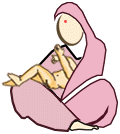
BREAST FEEDING SHOULD BE CONTINUED AND GIVEN
FREQUENTLY
Home therapy uses water, salt and starch (or protein)
alternatingly from fluids and food available at home.
| SALTED
FLUIDS |
UNSALTED
FLUIDS |
ORS Fluid
A Salted Drink
A Salted Soup
SSS - Sugar + Salt Soln |
Plain Boiled Water
Rice Starch
Soup (Unsalted)
Yoghurt Based Drinks
Tender Coconut Water
Weak Tea ( Unsweetened )
Fresh Fruit Juice |
Select more than 2 -3 different types of
fluids.Water should always be one of the selected fluids
What Fluids should not be given :
Potentially dangerous fluids can draw water by their high osmotic activity thus
aggravating dehydration
* Sweetened Fruit Drinks
* Sweetened Tea
* Most Soft Drinks
HOW TO DETECT DEHYDRATION:
Initially the child is thristy & irritable, the skin becomes less elastic, mouth is
dry and lips are parched, eyes appear sunken and there is a reduction in the quantity of
urine.
SEVERE DEHYDRATION;
Grave danger to life!!
Child becomes apathetic
Extremities becomes weak
Eyes are markedly sunken
Complete stoppage of urine
RUSH TO THE HOSPITAL ... EARLY
* When the child passes 10 Watery stools
* When there is associated vomiting
* When he is very thirsty
* When he has sunken eyes
* When he has fever
* When he refuses to eat and drink
* When he seems not to get better
* Associated Complications
Convulsions
Abdominal distention
Anemia
PREVENT DEHYDRATION COMPLICATIONS
HOW TO PREVENT DIARRHOEA
The crucial measure is to observe hygienic practices when feeding the baby and using safe
drinking water.
THE FOLLOWING ARE IMPORTANT :
1. Breast feeding exclusively until the age of 4 months
2.Hygienic weaning (introduction of semisolid food)
a) cups, katoris, spoons and all utensils should be cleaned well or boiled
b) Avoid using bottles
c) Fresh and hygienically prepared food, protect food from flies and dust
d) Avoid thermos and plastic ware which can not be boiled
3. Use boiled water. Store in covered containers
4. Wash hands with soap before feeding the baby and after defaecation, keep nails short
5. Immunizations like - Typhoid, Measles, Hepatitis etc. |
 |
IMPORTANT
NOTE :
This site presents material for your information and education. We can assume no liability
for inaccuracies, errors or omissions. Above all material on this site should not take the
place of the care you receive from your personal family physician. It is simply designed
to help in the understanding of diarrhoea in children and not as a diagnostic or
therapeutic aid. You should seek prompt medical care for any specific health issue. Please
feel free to download material for personal and non-commercial use. Neither is Dr. Rajni
Mukherjee nor Vizagcityonline.com in any way responsible for any complications / problems
that may arise. |


